The 10 Day Japan itinerary we actually send to clients
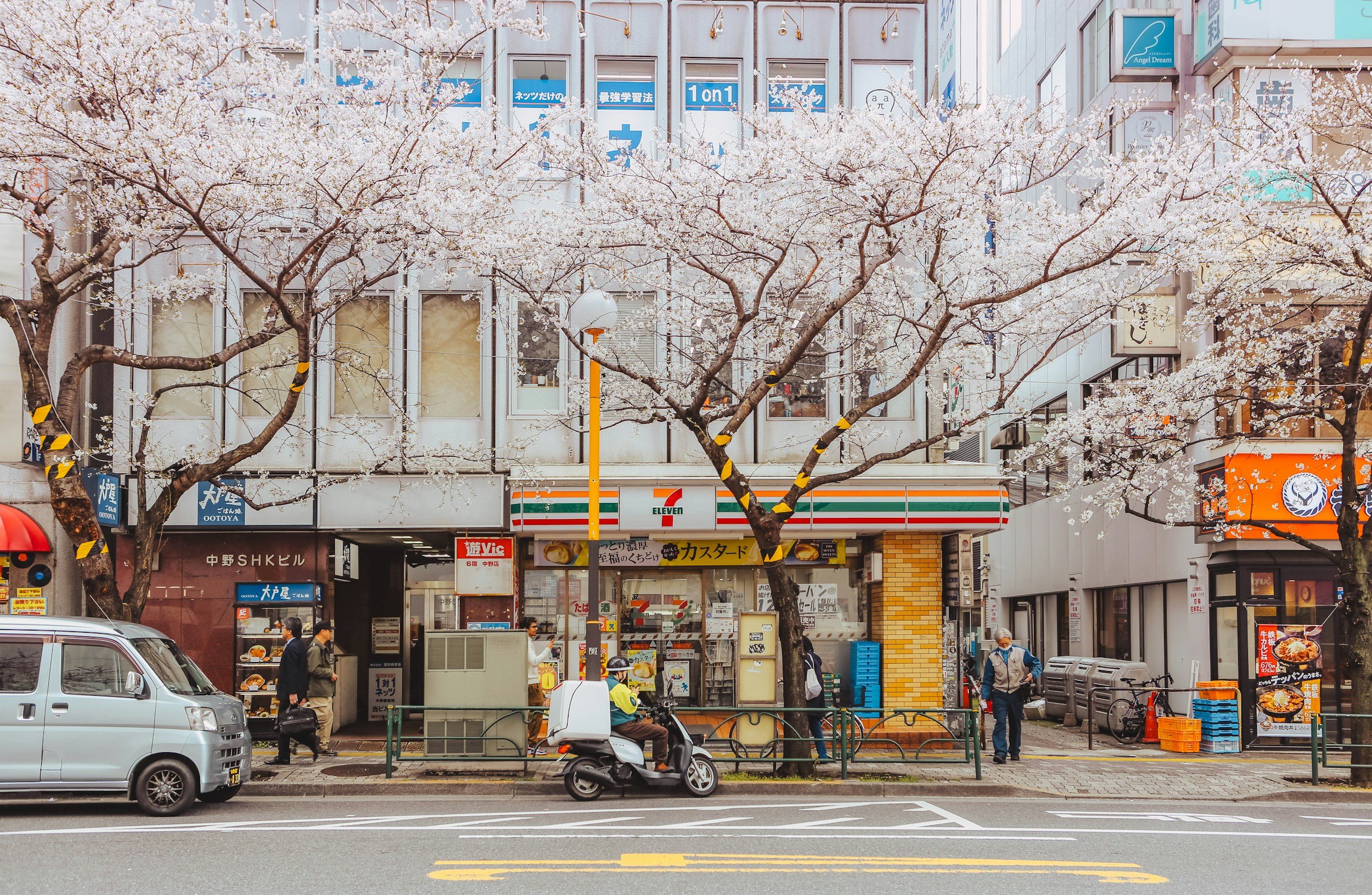
You have ten days, a decent budget, and roughly forty decisions standing between you and the trip. Which airport. Whether the JR Pass still pencils out. Whether Hakone is worth surrendering a night for. Whether the ryokan everyone raves about on Reddit is actually going to have a room.
This is the routing we book most often: Tokyo → Hakone → Kyoto → Nara → Osaka, flying home out of Kansai so you never retrace your steps. It's below, in full, for free. No email gate.
Treat this as a starting point, not a script. It's the skeleton we build from, and we reshape it every time — a honeymoon moves slower and eats better, a family with young kids needs different mornings entirely, and a couple chasing design hotels wants a different set of rooms than one chasing temples. Tell us what you're actually after and we'll bend this around it.
What you won't find on a blog is the second half of this page: the specific hotels we put clients into, sorted by the kind of traveler you actually are, with an honest note on who each one is wrong for. That comes from placing real people in these rooms and hearing about it afterward. These are just a sampling of hotels we love, but the real hotel matchmaking comes when you work directly with us.
The classic Japan itinerary, at a glance
Days: 10 (9 nights)
Route: Tokyo (3 nights) → Hakone (2) → Kyoto (3) → Osaka (1)
Fly into Haneda or Narita, fly home from Kansai (KIX) — book it open-jaw
When to go: depends entirely on what you want. See the seasons in the FAQ below
Pace: moderate. Two genuinely slow mornings built in on purpose.
Why this order matters more than the list of sights
Most 10-day itineraries you'll find are a list of attractions with the travel time quietly ignored. Four things about this routing are deliberate:
Hakone goes early, not late. Everyone's instinct is to save the onsen for the end as a reward. That's backwards. You will land in Tokyo wrecked from an 11+ hour flight and a 16-hour time shift, push through three hard city days, and hit a wall around day four. Enjoying a ryokan early on catches you exactly when you are adjusting to the new time zone. You soak, you enjoy a kaiseki, you sleep ten hours, and you arrive in Kyoto functional instead of grinding through the temples half-conscious.
Nara is not a day trip. Almost every itinerary sends you Kyoto → Nara → back to Kyoto, which burns 90 minutes of round-trip rail for no reason. Nara sits between Kyoto and Osaka. Do it as a stop on your transfer day: check out of Kyoto, forward your luggage to Osaka, spend five hours with the deer and Todai-ji unencumbered, then continue to Osaka that evening. That's a free half-day recovered.
Osaka is the departure city, not an afterthought. Kansai Airport is about 50 minutes from central Osaka versus three-plus hours back to Tokyo (and if you’re flying out of Narita, it’s even longer). Ending here means a civilized last morning instead of a 5am Shinkansen with your suitcases.
If you'd rather fly home from Tokyo, that's completely doable. The Shinkansen from Osaka back to Tokyo is straightforward and takes about two and a half hours. But in our experience the fare difference between an open-jaw ticket (into Tokyo, out of Osaka) and a plain round trip from Tokyo is usually small enough that it isn't worth giving up your last morning to travel. Compare both and decide, but don't assume open-jaw costs a premium.
We sequence around commute time, not just sights. Every day below is grouped geographically so you're not crossing a city twice. That sounds obvious and almost no itinerary does it.
On luggage: use takkyubin forwarding between cities. Your bags meet you at the next hotel the following day for a modest fee per piece. Nobody should be wrestling a large suitcase onto a Shinkansen or up a ryokan's stairs.
On the JR Pass: for this specific route, it usually does not pay off. The national pass rose sharply in late 2023, and with only two long hops — Odawara–Kyoto and Kyoto–Osaka — individual tickets are typically cheaper. Price it both ways; the answer changes with your exact routing.
Tokyo
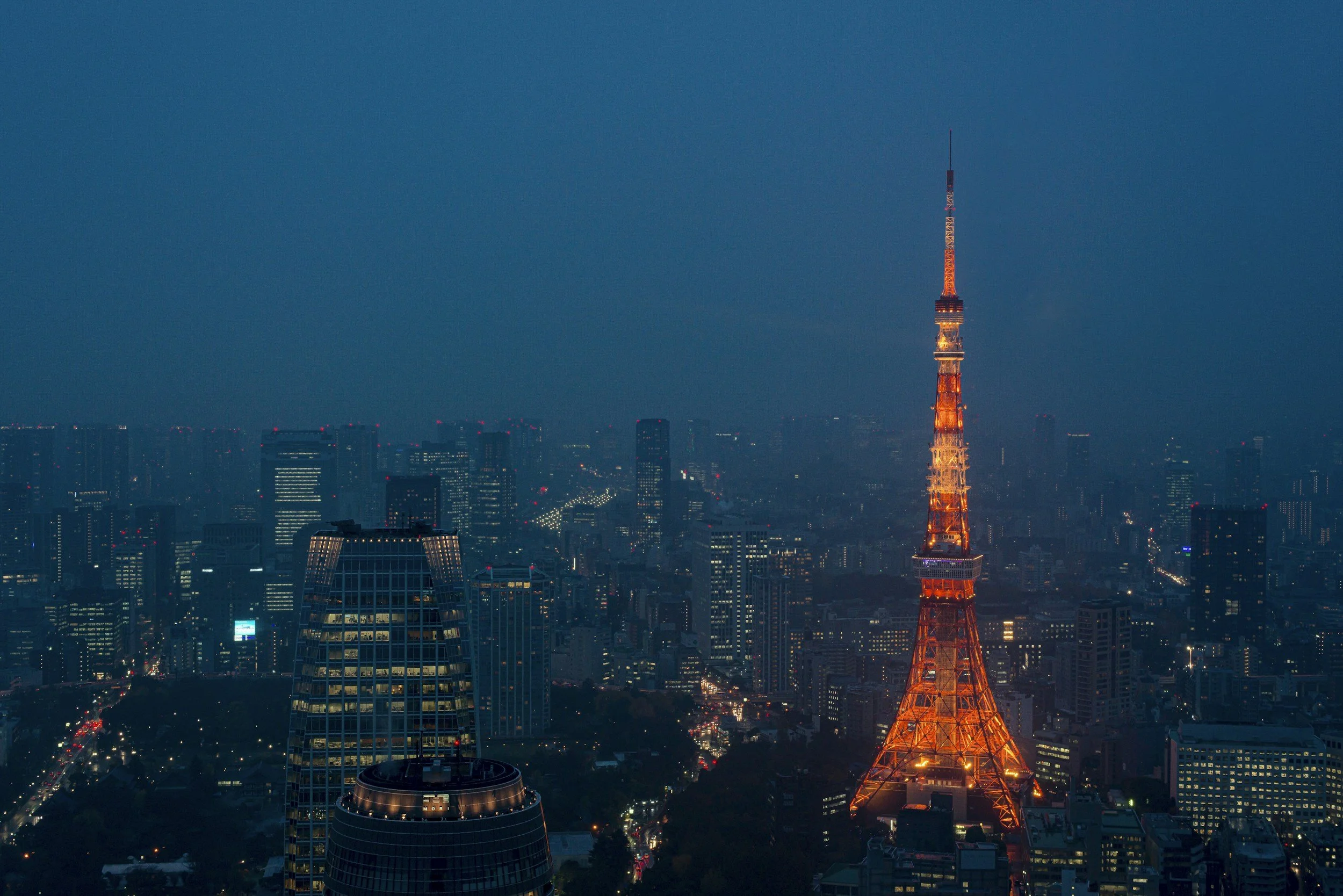
Tokyo was called Edo until 1868, when the emperor left Kyoto, moved into the shogun's castle, and the city was renamed "eastern capital." By the early 1700s Edo had passed a million residents and was probably the largest city on earth. Since then, the city has burned down and rebuilt itself repeatedly, through the 1923 earthquake and the 1945 firebombing. That's why Tokyo reads as relentlessly new: very little of it had the opportunity to get old.
What surprises most first-time visitors is that there's no downtown. Tokyo is a constellation of neighborhoods, each with its own station, its own center of gravity, its own character. And it holds more Michelin stars than any other city in the world — which, practically speaking, means the best meal of your trip might cost $12 at a counter with eight seats.
Day 1 — Arrive in Tokyo
Land at Haneda or Narita and transfer to your hotel. Do not schedule anything real today. Take a walk, eat something simple at an izakaya, and get sunlight on your face to start resetting your body clock.
Evening, if you have any energy left: wander the alleys of Shinjuku's Golden Gai. Tiny bars, six seats each, no plan required.
Day 2 — Tokyo: the Low City
A note on how we've split Tokyo: today runs through shitamachi, the "low city" — the eastern, flatter districts along the river where Edo's merchants, artisans and laborers lived in the past. Tomorrow covers the west: the neighborhoods that grew up in the 20th century around the Yamanote rail loop. Splitting the city across two different centuries makes it much easier to absorb this mega city’s history and vibe.
A few suggestions on where to focus your time today:
Tsukiji Outer Market first thing, ideally by 8am — an early sushi breakfast, tamagoyaki on a stick, knife shops. Go hungry.
Senso-ji in Asakusa, Tokyo's oldest temple, with a walk down Nakamise-dori
Ueno Park and the Tokyo National Museum
Akihabara in the evening for the arcades, electronics halls and anime culture
If you want to shop, we suggest:
Ginza is the flagship district. Global luxury houses in architecturally ambitious buildings, the Muji and Uniqlo flagships, Itoya's stationery floors, and Mitsukoshi's food hall in the basement. Come here if you want the brands you already know at their most impressive, or if you want department-store gifting done properly. On weekend afternoons the main avenue closes to cars and becomes a pedestrian promenade, which is worth timing for.
Nihonbashi is the older, quieter alternative, and the one we more often send people to. This was the merchant heart of Edo — the literal zero-milestone from which all distances in Japan were measured — and the shopping still reflects that: long-established specialty houses rather than international flagships. Knives, chopsticks, handmade paper, cast-iron kettles, textiles, family businesses several generations deep. Come here if you want to bring home something made in Japan by someone whose grandfather made it too.
Both options sit right on today's route, and they're genuinely different experiences, so pick by what you're after rather than by proximity.
Short version: Ginza for labels and spectacle, Nihonbashi for craft and provenance. Ginza is more fun to walk with a coffee; Nihonbashi is where the better souvenirs are.
Day 3 — Tokyo: the West Side
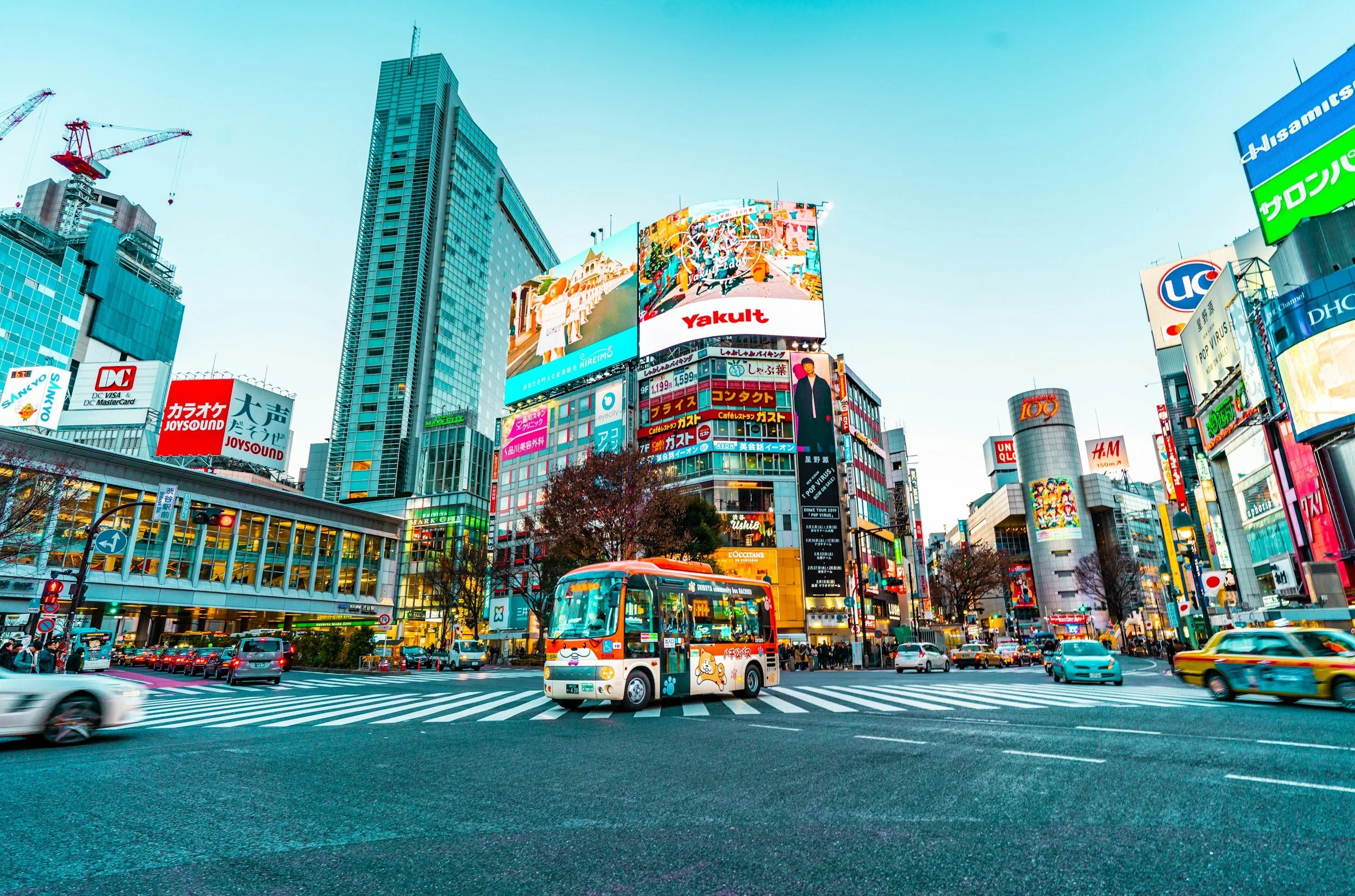
Highlights include:
Meiji Shrine, then Harajuku's Takeshita Street and the calmer flagship stretch of Omotesando
Shibuya Scramble Crossing, then up to Shibuya Sky for sunset — book a timed slot in advance, it can sell out in busier months
teamLab if digital art appeals; also timed-entry and also sells out
Shopping: If Ginza is department stores and Nihonbashi is craft, the west side is fashion, design and browsing. Here are some picks from our team:
Omotesando and Aoyama — the flagship mile, worth walking even if you buy nothing, because the architecture itself is the attraction: Prada Aoyama by Herzog & de Meuron, Dior by SANAA, Tod's by Toyo Ito. Then turn south into Aoyama and it quiets into Japanese designer fashion at its source: Comme des Garçons, Issey Miyake, Yohji Yamamoto at their proper flagships.
Cat Street and the Ura-Harajuku backstreets — Independent Japanese labels and genuinely good vintage. The reasoning: this is where you find things you can't buy at home, which for a lot of people is the whole point of shopping abroad.
Daikanyama — One stop from Shibuya, low-rise and leafy, small boutiques, Tsutaya Books at T-Site. Positioned specifically as the antidote when Shibuya and Harajuku crowds start to grate — which, for a 45-year-old on day three of a trip, is usually around 2pm.
Shibuya for the practical version — Scramble Square, Parco, Loft, Hands. Best souvenir shopping in the city per dollar.
While not on the itinerary for most travelers, if you are a fan of Studio Ghibli, we highly recommend booking a visit to the Studio Ghibli museum as soon as you can.
If you’re looking for dining or activity recommendations, get in touch with us via the booking form at the end of this article.
Day 4 — Tokyo to Hakone
Late morning: Shinkansen from Tokyo Station to Odawara — about 35 minutes. From Odawara, the Hakone Tozan Railway climbs into the mountains by switchback, reversing direction three times as it gains elevation, which is genuinely part of the fun. Or take a bus or taxi straight to your ryokan.
Why not the Romancecar: it's the more famous option, but it leaves from Shinjuku and takes roughly 90 minutes. If you're staying anywhere near Tokyo Station you're already where the Shinkansen is, and you'll be soaking an hour earlier.
Check into your ryokan, get into the onsen before dinner, and let the kaiseki dinner take the whole evening. This is the night people talk about a year later.
Hakone
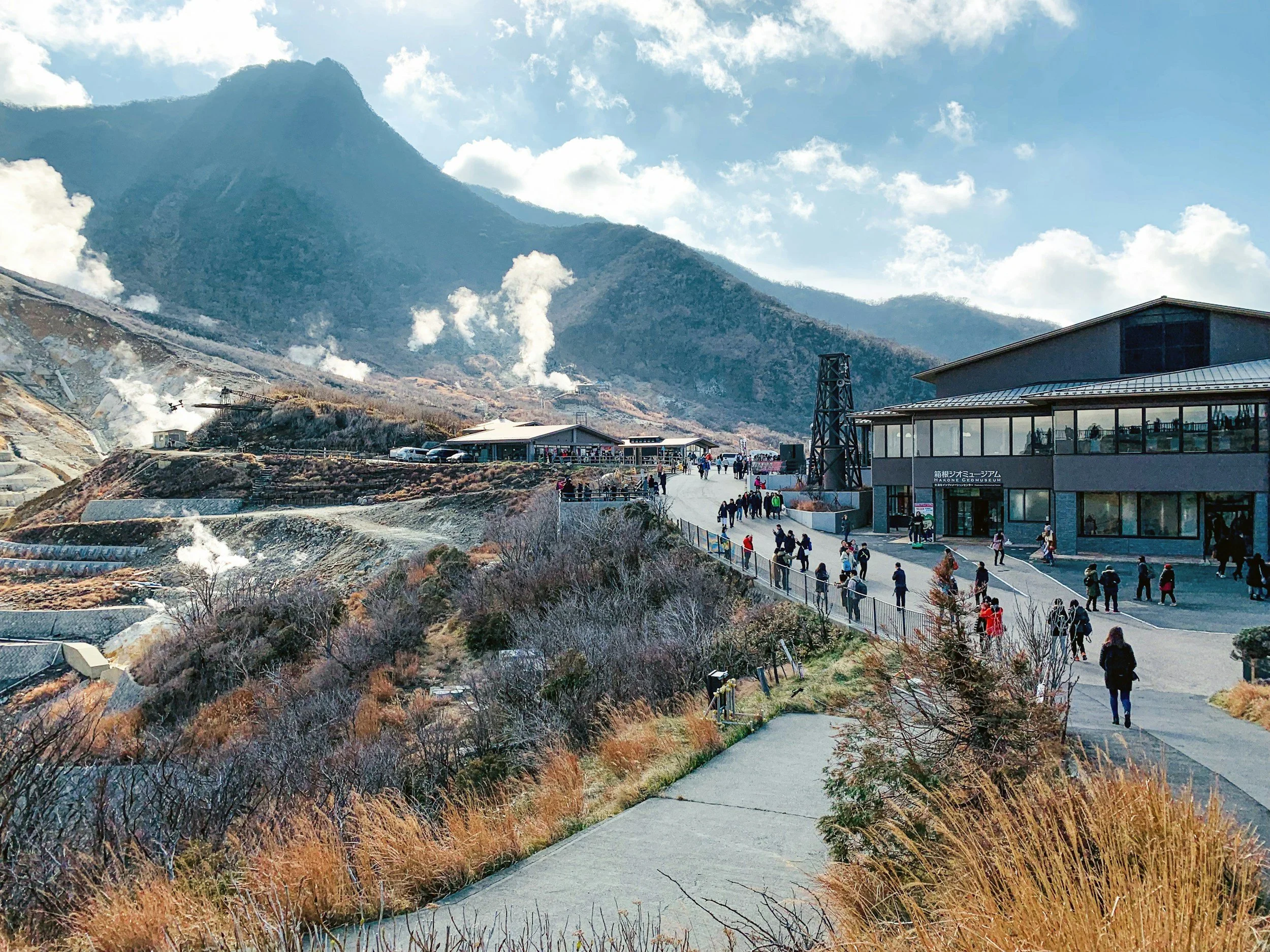
From Tokyo, head to Hakone. Hakone sits inside the caldera of a volcano that is still actively venting steam, which is the whole reason the hot spring water is there. It has been a place to stop and rest since the Edo period, when it was a checkpoint on the Tokaido highway between Edo and Kyoto. Pausing here on your way between Tokyo and Kyoto is part of the original route these travelers of the past embarked on, and a nice nod to these old journeys. On a clear day, you can see Mount Fuji is right in front of you from many different angles.
Day 5 — Hakone
Do it as a loop, in this order — it matters:
Hakone Ropeway first, over the sulphur vents of Owakudani
Lake Ashi cruise from Togendai
Hakone Open-Air Museum on your way back toward Gora
Back to the onsen before dinner
Why this order: Mount Fuji is most likely to be visible in the early morning: clouds build through the day, and by afternoon your odds drop considerably. The ropeway is where you'd see it, so it goes first while the sky is still working in your favor. It also means the Hakone circuit runs in one continuous direction instead of doubling back, and the Open-Air Museum sits a stop from Gora so it lands naturally at the end. You can also do this loop in reverse, though it can significantly decrease your odds of seeing Fuji.
Not sure why ryokan to pick? Check out our ryokan guide.
Day 6 — Hakone to Kyoto
Down to Odawara, Shinkansen to Kyoto — about 2h15m. Check in, then walk Pontocho Alley as the lanterns come on and eat your first Kyoto dinner somewhere narrow.
Kyoto
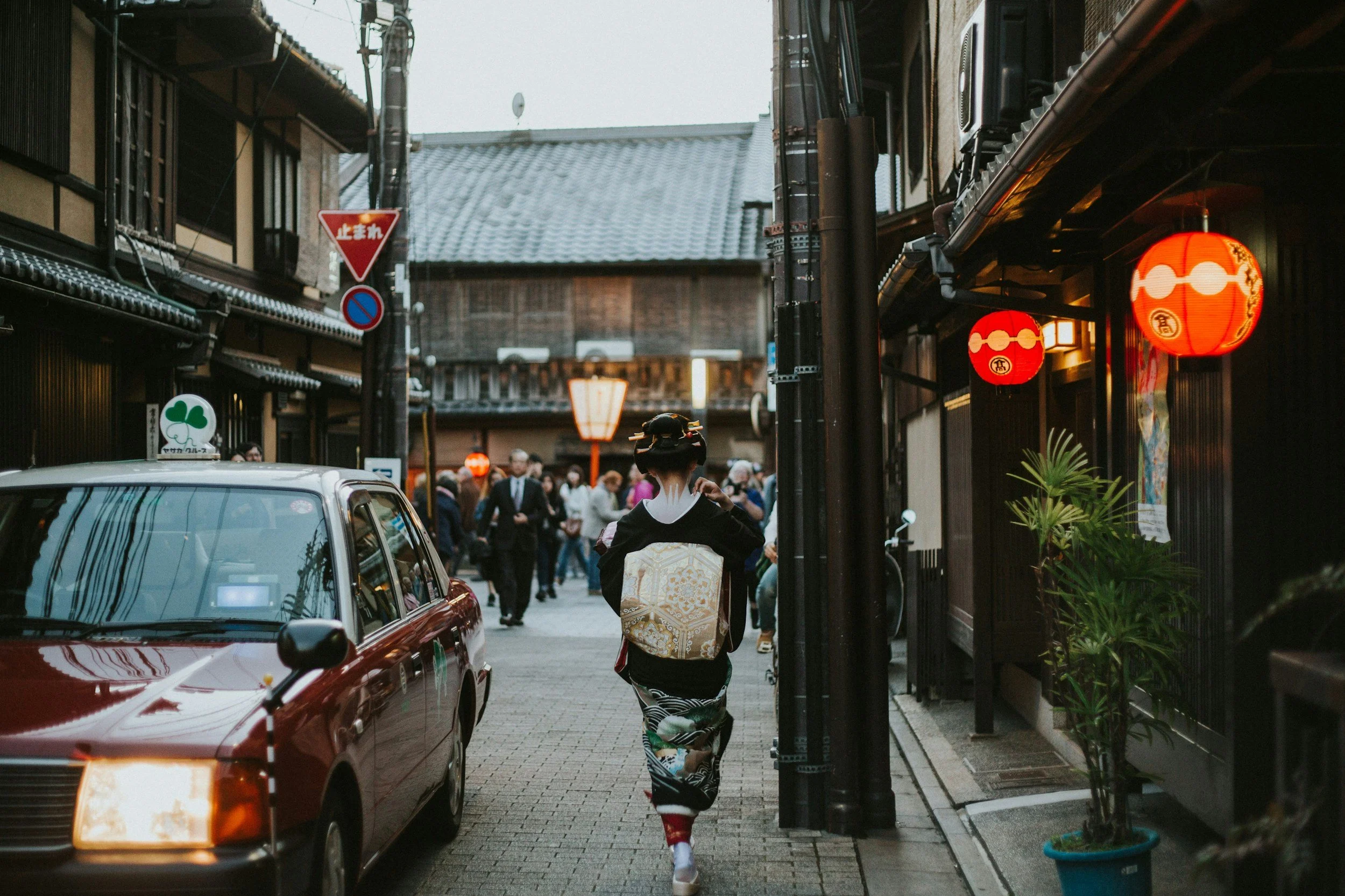
Kyoto was Japan's imperial capital for over a thousand years, from 794 until the court moved to Tokyo in 1868. Critically, it was spared the WWII firebombing that flattened most Japanese cities, so unlike Tokyo, what's standing here is genuinely old. There are more than 1,600 Buddhist temples, some 400 Shinto shrines, and 17 UNESCO World Heritage sites inside the city limits. With so much to do and see in Kyoto, we can help you narrow down the temples to focus on, but for those who want the hits, check out our recommendations below.
Day 7 — Kyoto: south and east
Fushimi Inari at 7am. Not negotiable, and jet lag is on your side here. The torii paths are transcendent at dawn and a slow-moving queue by ten.
Head north to Higashiyama for Nanzen-ji — a huge Zen complex with an unexpected brick aqueduct running through it, and far fewer people than its fame deserves
Walk the Philosopher's Path, the canal-side route lined with cherry trees that a Kyoto University philosopher used for his daily commute
Enjoy a traditional tea ceremony in the afternoon in Gion, the geiko district. Afterwards, you’ll be perfectly situated to explore the neighborhood’s wooden machiya facades, which is best at dusk.
Optional experiences, both excellent:
Some links below are affiliate links. We may earn a small commission at no extra cost to you, and we only recommend experiences we'd book ourselves.
A one-hour beginner Japanese archery (Kyudo) workshop: learn proper form, the tools and techniques, and the history of the practice as a traditional martial art. All equipment is provided; bring comfortable clothes and some curiosity.
Paint your own Daruma: a cultural ritual for expressing your purpose and your story, and you go home with the thing you made.
Day 8 — Kyoto: Arashiyama and the west
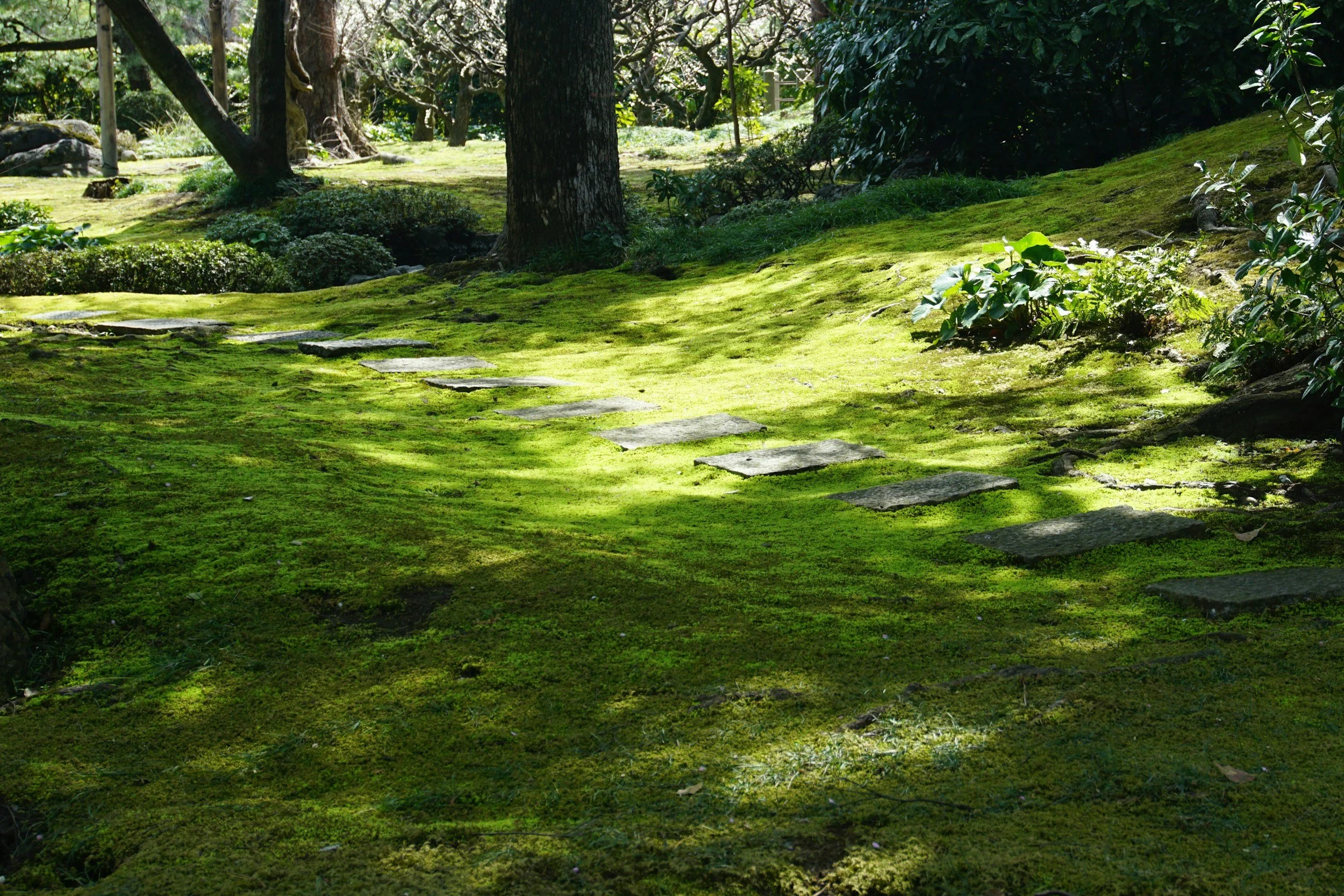
On the Bamboo Grove: skip it unless it's genuinely on your bucket list. It's one short, extremely crowded path, it photographs far better than it feels, and the four things below are more rewarding uses of the same morning.
Early morning: Saihō-ji (Kokedera), the moss temple. Gorgeous grounds carpeted in more than a hundred varieties of moss. Reservations are required in advance — don’t miss this serene temple because you didn’t set a reservation in advance! Pro-tip: reservations open 2 months prior to the date of entry.
Tenryu-ji, the head temple of its Zen branch, with a garden designed in the 14th century that has survived intact
Saga-Toriimoto Street, a preserved lane of traditional machiya and thatched buildings that looks much as it did centuries ago
Adashino Nenbutsu-ji, a poignant Buddhist site tucked among the hills. This temple honors the souls of the forgotten dead with more than 8,000 small stone Buddha statues arranged in solemn rows. The surrounding bamboo groves and quiet grounds create a deeply moving and serene atmosphere — and if you want bamboo, this is the version worth having. In spring you might catch cherry blossoms softening the stone landscape.
Optional: Iwatayama Monkey Park and the Togetsukyo Bridge
If you need the postcard icons: Kinkaku-ji (the Golden Pavilion) and Nijo Castle are both reachable on the way back east, and both are worth seeing. But adding them makes this a genuinely long day. Our honest read is that the west-Kyoto morning above is the better trip, and Kinkaku-ji is the one to add if you only add one. This is exactly the kind of trade we help clients make against their own priorities.
Day 9 — Kyoto to Nara to Osaka
Check out and forward your luggage ahead to Osaka. Train to Nara, roughly 45 minutes.
Nara
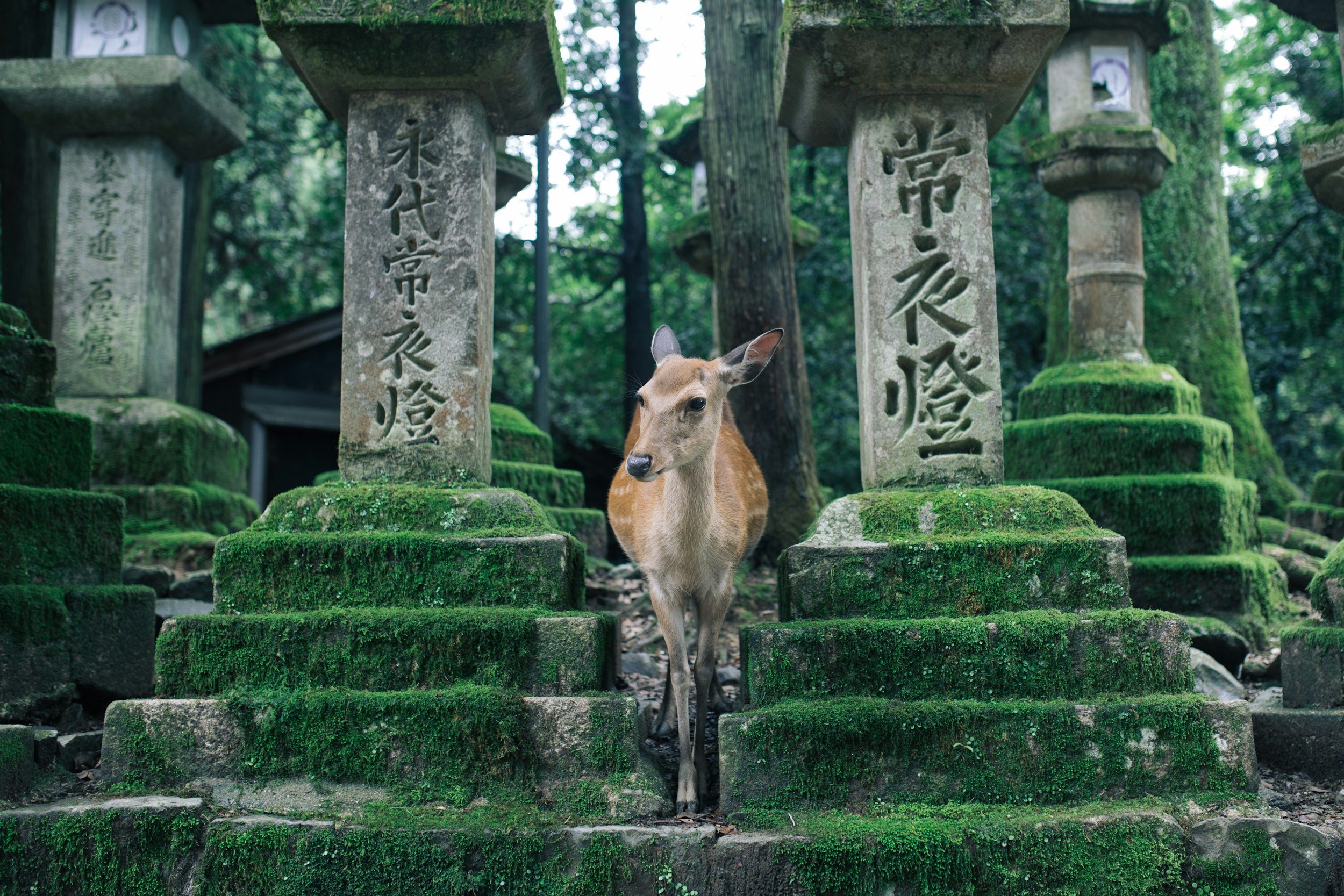
Nara was Japan's first permanent capital, from 710 to 794, which makes it older than Kyoto. The court moved on after 74 years, and because Nara stopped being the center of power so early, a great deal of it simply stayed as it was. There are eight UNESCO World Heritage sites in a town you can cross on foot, including Todaiji and it’s famous Great Buddha, which was cast here in 752 and has been sitting in the same spot ever since.
Then there are the deer. Over a thousand of them roam free through the park, descended from herds considered messengers of the gods at Kasuga Taisha. Deer was seen as a sacred animal, and killing deer was a capital offense until 1637. The deer have since learned that bowing to tourists produces crackers, which is as charming as it sounds until one of them decides your map, your ticket, or your tote bag also qualifies as food. Hold your paper things above your head and make sure any snacks you have are sealed away (or better yet, avoid bringing them).
It's compact, and that's the point: the park, Todaiji and Kasuga Taisha sit within one walkable area, which makes Nara an efficient half-day stop on your transfer rather than an overnight stay.
Highlights in Nara include:
Nara Park, where over a thousand deer roam free and bow for crackers
Todai-ji, one of the largest wooden buildings on earth, housing a 15-metre bronze Buddha
Kasuga Taisha and its stone lanterns
Nakatanidou for traditional, freshly-made mochi. During the day you may catch them pounding it — they hold the Guinness World Record for mochi-pounding speed, and it's worth asking when the next demonstration is. They're especially known for yomogi mochi, flavored with Japanese mugwort and filled with smooth, sweet red bean paste (anko).
Continue to Osaka in the evening. Walk the Dotonbori canal — enjoy a beer and some of Osaka’s most iconic dishes — takoyaki and okonomiyaki — the Glico running man, more neon than any photograph conveys.
Osaka
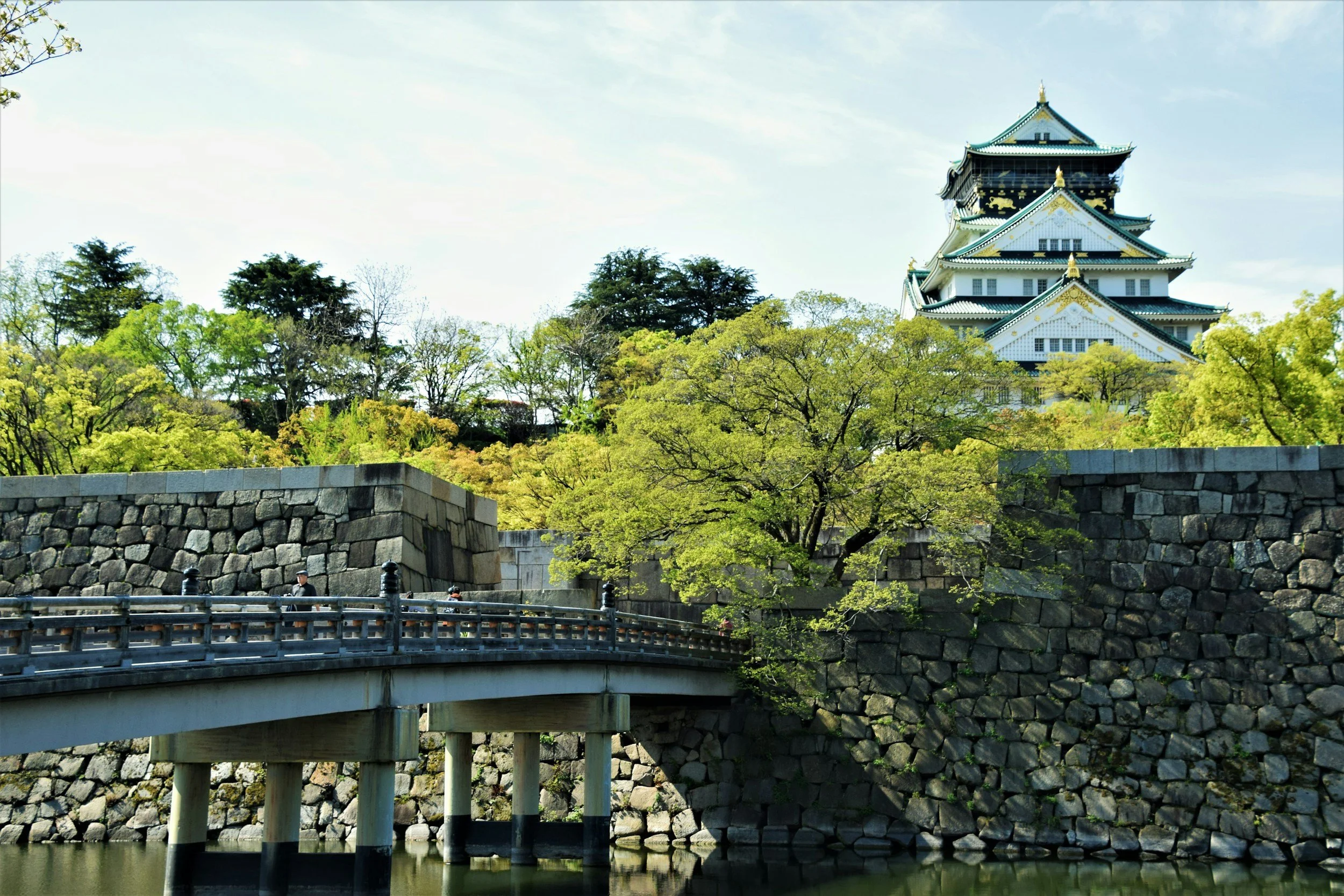
Kyoto had the emperor and Edo had the shogun, but Osaka had the money. Through the Edo period this was the country's commercial engine — rice and goods from every province were traded and warehoused here, which earned it the nickname tenka no daidokoro, "the nation's kitchen." The traditional Osaka greeting was reportedly "mōkarimasu ka?" — literally "are you making money?" That tells you most of what you need to know.
Four hundred years later the city still runs on that character, and the food is where it shows. Osaka coined its own word for the local approach — kuidaore, roughly "eat yourself into ruin" — and it is used as a compliment. Takoyaki, okonomiyaki, kushikatsu: none of it is refined, all of it is very good, and after eight days of kaiseki and temple gardens that turns out to be exactly what you want.
Osakans have a reputation for being blunter, funnier and warmer than Tokyoites, they speak a noticeably different dialect, and the city is the acknowledged capital of Japanese comedy. One small tell that you've genuinely changed cities: in Tokyo you stand on the left of the escalator, and in Osaka you stand on the right. Get it wrong and someone will let you know.
Why we put it last: this is the exhale. Kyoto asks you to be reverent and Tokyo asks you to keep up. Osaka just wants to feed you, which makes it the right final night — and Kansai Airport is 50 minutes away instead of three hours.
Day 10 — Departure
A slow morning. Osaka Castle if you want one last thing, or Kuromon Ichiba market for breakfast. Then 50 minutes to Kansai and home.
If you'd rather have two nights in Osaka: trim Hakone to a single night. You lose the second onsen day, which is a real loss, but it's the cleanest place to find the time.
Where to stay
This is the part that takes clients weeks. Hotels in Japan are not sorted by star rating so much as by personality, and a room that delights one traveler quietly disappoints another. So here they are by the kind of traveler you are.
Tokyo hotel recommendations
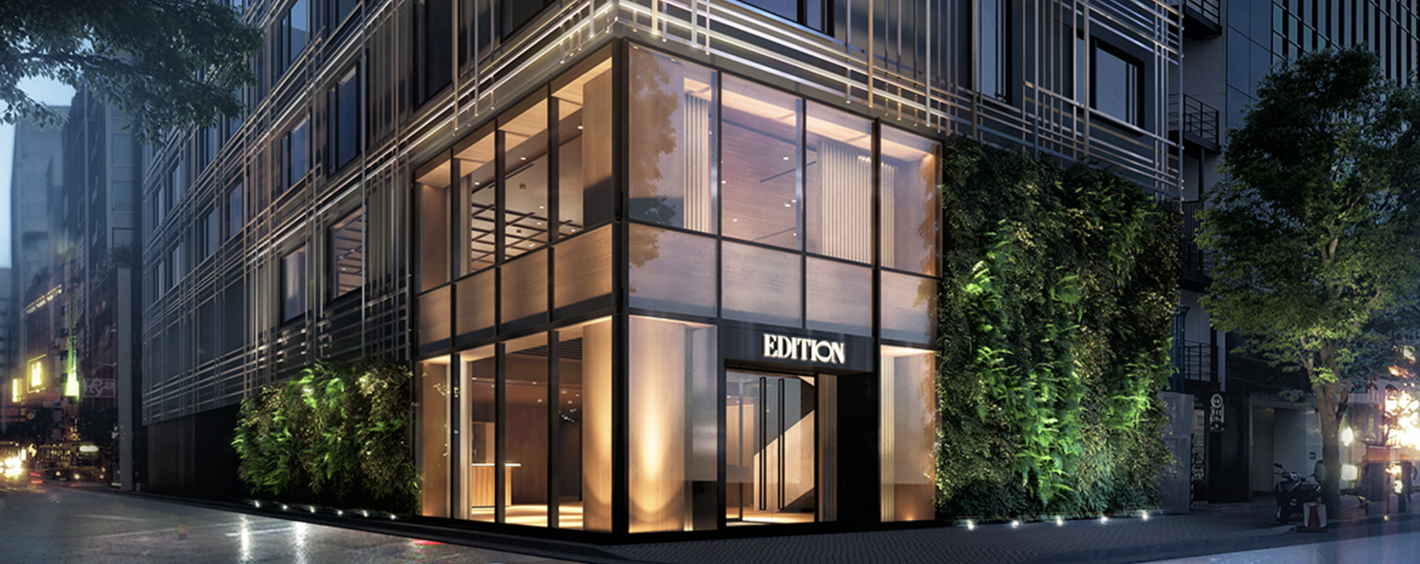
The Tokyo Edition Ginza Hotel. Photo Credit to the Tokyo Edition Ginza.
Classic luxury, city energy
Four Seasons Otemachi or Tokyo EDITION Ginza. Great locations and the familiar comforts of a hotel you already know how to use.
Why we book it: Otemachi is the underrated call for this exact routing. It sits minutes from Tokyo Station, so your Hakone Shinkansen on Day 4 is a short taxi rather than a cross-city haul with luggage. Shinjuku photographs better. Akasaka is more affordable. Otemachi works better.
Not for you if: you want to step out of the lobby into street life. Otemachi is a financial district and it goes quiet after dark — which, on jet lag, many clients end up grateful for.
Modern and clean, natural materials
1 Hotel Tokyo or Muji Hotel Ginza. Greenery, wood, stone and lightly rugged finishes that still read as refined. Muji in particular is soft lighting, warm wood and pale tones.
Why we book it: these are the rooms for people who find conventional luxury a little heavy. Muji Ginza also puts you directly upstairs from the flagship store, in the middle of Ginza.
Not for you if: you equate luxury with marble and a butler. Muji's rooms are compact by design. That's intentional.
Ryokan-inspired, in the middle of the city
FUFU Tokyo Ginza or Hoshinoya Tokyo. Minimalist rooms with washi doors and tatami, traditional kaiseki dinners, the feeling of a retreat after a loud day.
Why we book it: Hoshinoya is a genuine ryokan stacked vertically in the middle of Tokyo, with an onsen at the top. You leave your shoes at the door on the ground floor. For a first-timer it delivers the ryokan experience without spending a travel day to reach it.
Not for you if: you're already doing a ryokan in Hakone and would rather your Tokyo hotel feel different. Two ryokan stays in one trip can blur.
Boutique
SOIL Nihonbashi. Small, design-led, and in a neighborhood most visitors walk straight past.
Why we book it: we love supporting a beautiful design hotel that embodies the local spirit. With a few locations throughout Japan, each feels unique to the location it exists in, and travelers will love the unique design touches.
Apartment-style, for families and groups
MONday Apart Premium Asakusa or Hyatt House Tokyo Shibuya. A kitchen, and a dining table you can all sit around.
Why we book it: with kids, being able to make breakfast at 5am when everyone's jet-lagged and starving is worth more than any hotel amenity. Space to spread out beats a nicer lobby every time.
Hakone hotel recommendations
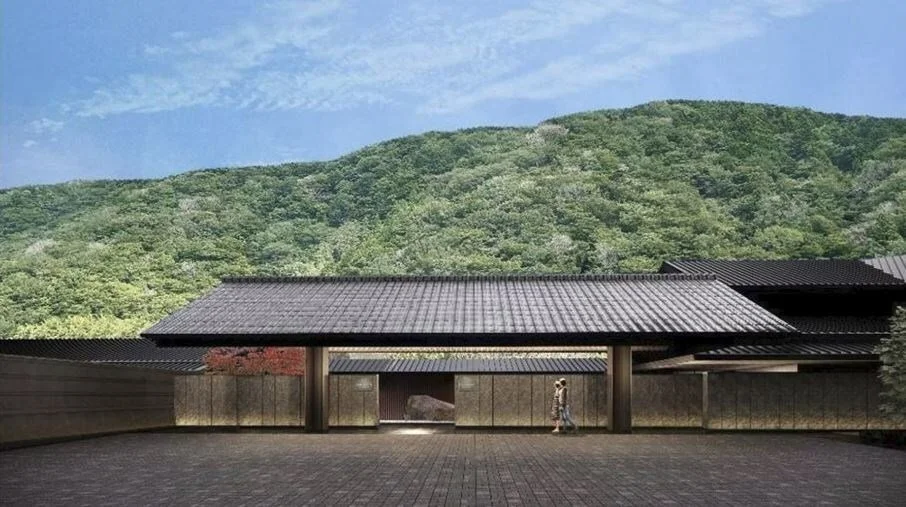
A rendering of the Hotel The Mitsui Hakone. Photo credit to Marriott.
Gora Kadan is what everyone recommends, and for good reason — it's the benchmark for Hakone hospitality, set in traditional Japanese architecture, with private open-air baths for the soak you came for.
The honest problem: it sells out, often months ahead, and especially in autumn and blossom season. If you're reading this inside six months of your dates, plan on it being gone.
Our alternates, which are not consolation prizes:
ESPACIO The Hakone Geihinkan Rin-Poh-Ki-Ryu — beautiful, exceptional service, the sense of being folded into the mountains
HOTEL THE MITSUI HAKONE — opening December 15, 2026, set inside Fuji-Hakone-Izu National Park, so you're looking at protected landscape rather than other buildings. The sibling property to HOTEL THE MITSUI KYOTO (our gold-standard Kyoto pick), and reservations are already open. Nobody has stayed yet, ourselves included — we're recommending it on the brand's Kyoto track record and the setting.
Hotel Indigo Hakone — the mid-range pick that punches well above its price: a private onsen in every room, and river or mountainside views
Why this matters: the ryokan night is the emotional center of this trip. When Gora Kadan is unavailable, most travelers default to whatever has rooms. Knowing the second tier this well is most of the value of working with an advisor.
Kyoto hotel recommendations
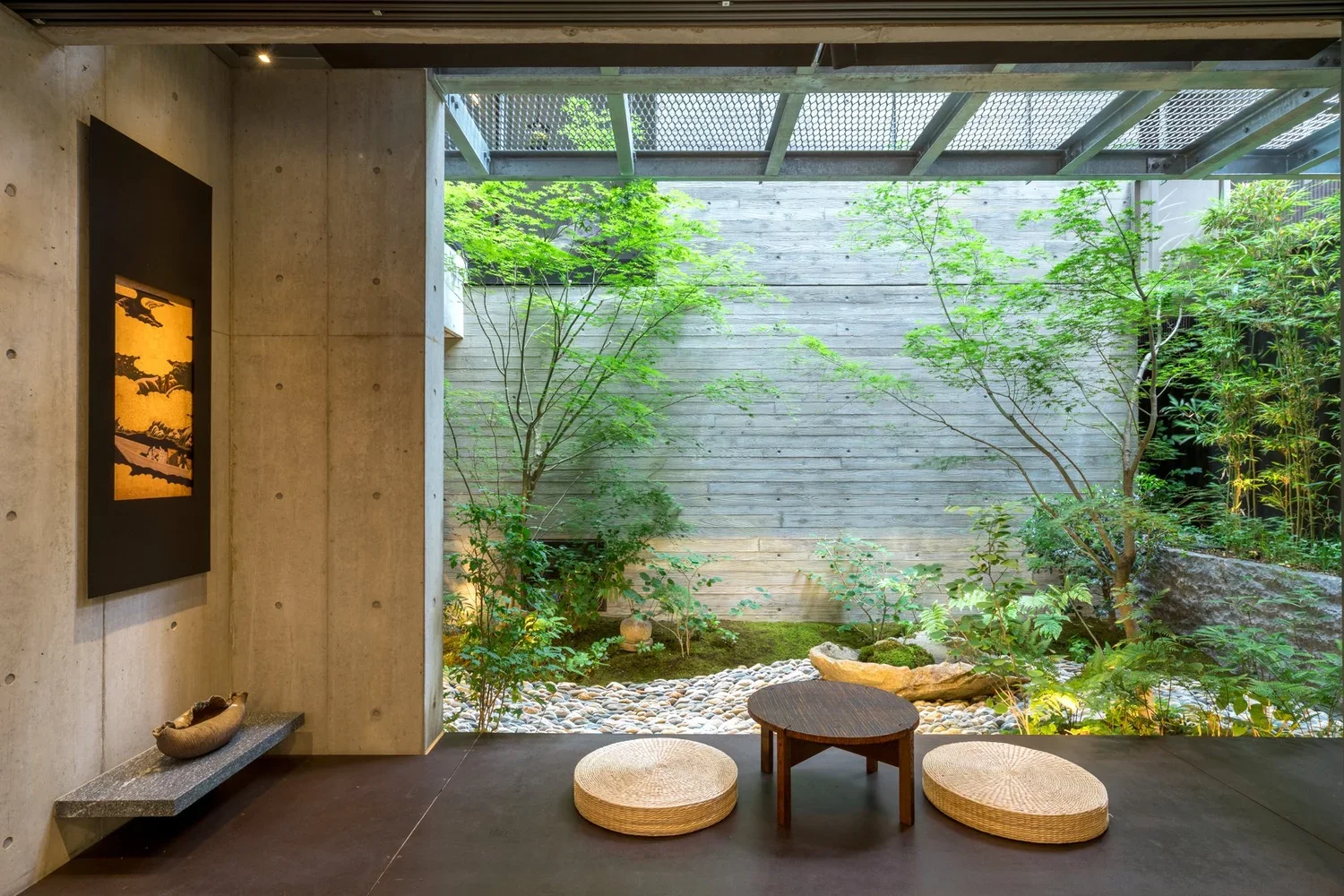
Interior of the Genji Kyoto. Photo credit: Genji Kyoto.
The gold standard: HOTEL THE MITSUI KYOTO. If you want the best in the city, it's this.
Design-forward with a river view: Genji Kyoto. Beautifully designed rooms overlooking the water.
Central and ryokan-inspired: Hotel Kanra Kyoto. Traditional design language, walkable to nearly everything.
Boutique and intimate: Kanamean Nishitomiya. Classic Kyoto design and service, only eight rooms.
Why location matters more in Kyoto than anywhere else: Day 7 starts at Fushimi Inari at 7am and Day 8 needs you across town in Arashiyama by mid-morning. A central hotel makes both pleasant. A hotel out by the station makes them a chore, and most people quietly skip one.
On Kanamean: eight rooms means it books out early, and it means service that remembers your name by day two. It also means no gym, no room service, and no anonymity. Some travelers love exactly that. Some don't.
Osaka hotel recommendations
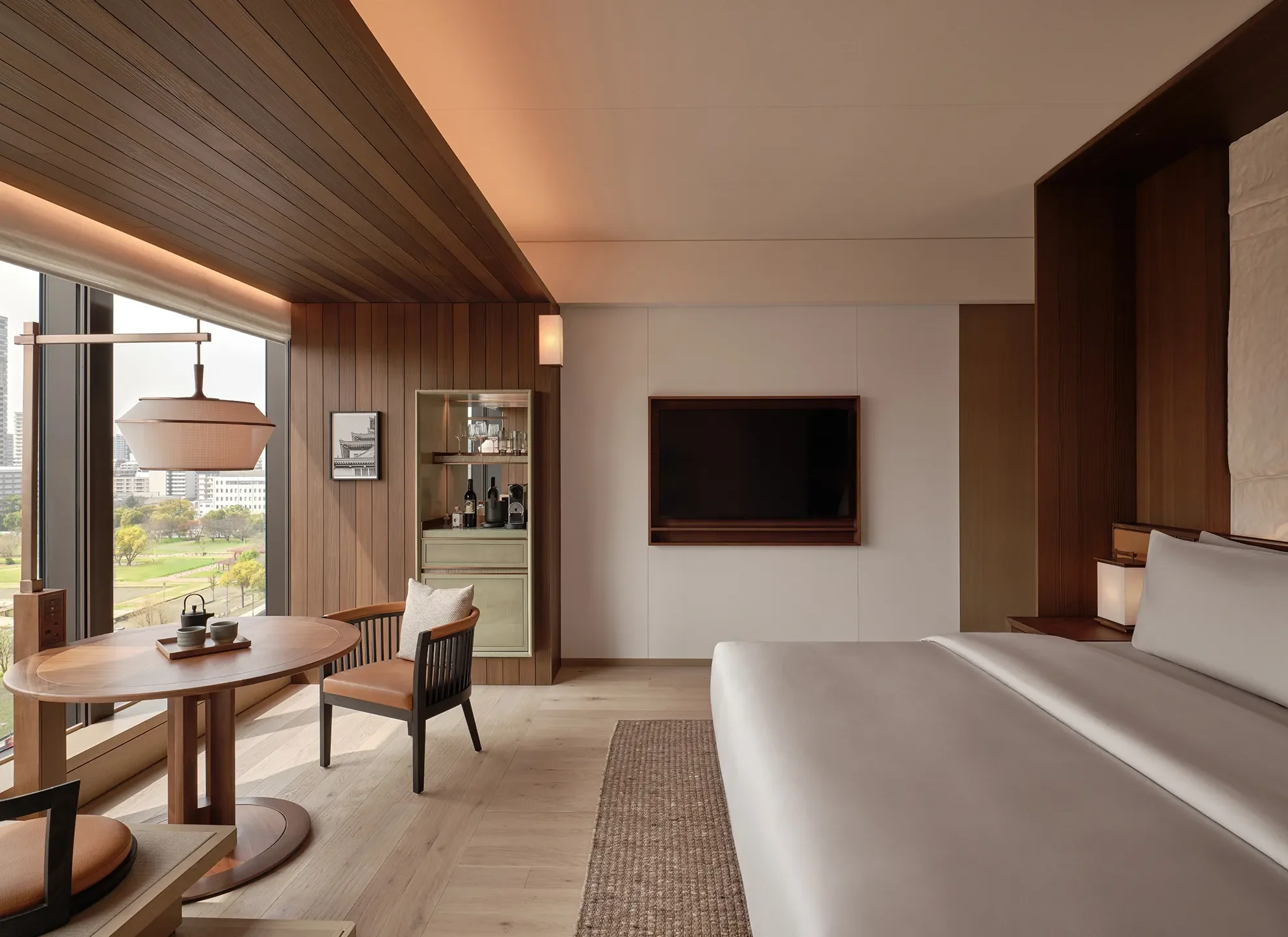
Deluxe room at the Patina Osaka. Photo credit: Patina Osaka.
Patina Osaka — a modern, ultra-luxury sanctuary near Osaka Castle, for the traveler who cares about design. Named the No. 1 hotel in the world in the 2026 Travel + Leisure World's Best Awards — also No. 1 in Asia, and the first Japanese hotel ever to take the top spot.
Zentis Osaka — further north in the business district, but an affordable modern luxury hotel that's beautifully done.
Citadines Namba Osaka — apartment-style, right for families and friend groups.
Mitsui Garden Hotel Osaka Premier — for the traveler who says they don't care where they sleep but, let's be honest, probably does. Affordable, compact, clean aesthetics, genuinely nice.
Why we book it: you're here one night before a flight, so a suite you'll see for eleven hours is usually the wrong allocation — unless the hotel is itself a reason to come, which Patina now unambiguously is. If you want to build a night around a hotel, this is the one on this route worth doing it for.
What 10 days in Japan roughly costs
Per person, excluding international flights:
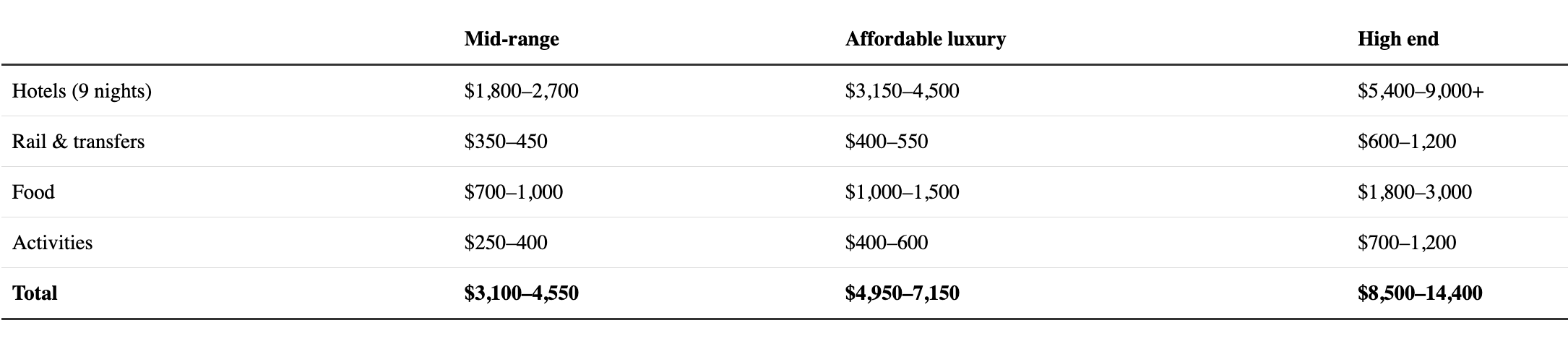
Please read these as broad estimates, not quotes. Actual costs move considerably with the time of year you travel, what inventory is available when you book, how far in advance you commit, and the exchange rate. Cherry blossom season and autumn color carry real premiums; the same hotel can differ substantially between March and June. We'll price your specific dates properly.
The ryokan night is the single biggest swing. Gora Kadan-tier properties run several times a normal hotel night because dinner and breakfast are included and are a substantial part of what you're buying.
What working with us changes
You can book all of this yourself. Plenty of people do. Here's what's different when we handle it.
Preferred partnerships. We hold preferred status with luxury hotels worldwide — Four Seasons, Rosewood, and most of the properties above. That typically means a room upgrade at check-in when available, daily breakfast, a property credit, and early check-in or late checkout. At the same rate you'd pay booking direct. Ten days across four hotels, and it adds up to real money.
Restaurants and experiences that aren't on this page. What's above is the public version. The reservations worth chasing, the counter with eight seats that doesn't take walk-ins, the workshop that suits the way you like to spend an afternoon — that gets matched to your interests after we’ve have a conversation. There's an enormous amount of on-the-ground detail we've collected first-hand that is simple too much to put in a single post.
We optimize your schedule so you commute less and enjoy more. Most self-planned trips lose several hours a day to badly ordered days — crossing a city twice, arriving as something closes, queueing at the worst hour. We sequence around geography and opening times so your time goes where you actually wanted it.
We know what's actually available. When Gora Kadan is gone for your dates, we don't hand you a search results page. We know which alternates hold inventory and which of them your specific trip should use.
Someone is on it when it goes wrong. A typhoon closes the ropeway. Your flight shifts and three hotels need moving. That's a phone call that we can handle, not your problem.
We've been there. Our founder has traveled to 33+ countries and stayed in these properties. The commentary above isn't aggregated from reviews.
How it works: hotel bookings are free — we place the reservation, you get the perks. Full custom itinerary planning starts at $450. If you travel often, we offer a dedicated concierge for a flat monthly fee.
This itinerary is a starting point. Let's talk and we'll customize it around your interests and your situation — honeymoon, family trip with young kids, a milestone birthday, a group where everyone wants something different.
Frequently asked questions
Is 10 days enough for Japan?
Yes, for a first trip, though if you can swing 12 or 14 days that would be even better to allow for a more leisurely pace (or a few day trips). Ten days covers Tokyo, one onsen town, Kyoto, and Osaka at a moderate pace without the trip becoming a series of train stations. It's not enough to add Hiroshima, Kanazawa, or Hokkaido — attempting that turns ten days into a blur. Save them for the second trip, which most of our clients end up taking.
How much does a 10 day trip to Japan cost?
It varies more than most people expect. Hotels drive the majority of the difference, and the ryokan night is the single biggest line item. Season matters enormously; the same trip in cherry blossom season versus early June can differ substantially. See the estimate ranges above for a rough shape, then let us price your actual dates.
What's the best time of year to go?
It depends entirely on what you're after, and there's no single right answer.
Spring (late March–early April) is the most popular, for the cherry blossoms. It's genuinely spectacular and it is genuinely crowded and expensive. Book 6–9 months out.
Autumn (late October–November) brings the maple color, and much the same story on crowds and pricing.
Winter is underrated and can be wonderful, with noticeably smaller crowds, beautiful snow scenery, steam rising off an outdoor onsen in the cold, and world-class skiing and snowboarding if you want to add Hokkaido or Nagano.
May and early June are the quiet sweet spot: pleasant weather, thinner crowds, better rates. Be aware that June brings rain.
July and August are hot and humid, though it's festival season. It does get busy since lots of people have the summer off, but the weather can be brutal if you’re not used to the humidity.
Is the JR Pass worth it for this itinerary?
Usually not. After the 2023 price increase, a route with only two long rail hops rarely justifies the national pass. Individual tickets typically come out cheaper. Price both before committing.
Do I need to speak Japanese?
No. Signage in major cities and on the rail network is bilingual, and translation apps handle the rest. A dozen polite phrases will noticeably improve how your trip goes.
Should I fly out of Tokyo or Osaka?
We always prefer minimizing travel time so we'd suggest Osaka (Kansai) — it's about 50 minutes from central Osaka versus three-plus hours from Tokyo, so you get a relaxed final morning. If you'd rather depart from Tokyo, the Shinkansen back takes about two and a half hours and works fine. In our experience the fare gap between open-jaw and a plain round trip from Tokyo is usually small, so choose on how you want to spend your last day rather than on price.
Is Hakone worth spending a night in?
To get a different taste of Japan, yes it is worth spending a night in Hakone (Looking for a ryokan? Check out our guide to Hakone ryokans here). It's the only place on this route where you can get out of a large city and see some of Japan’s beautiful landscape, and it’s perfect for when jet lag peaks. If you're traveling with kids under six or you strongly dislike communal bathing, it's the fairest thing to cut.
Can you customize this for a honeymoon or a family trip?
That's most of what we do. A honeymoon usually means slower mornings, better dinners, and a ryokan with a private bath. A family trip means apartment-style hotels or hotels with connecting rooms, shorter travel days, and building around what actually holds kids' attention. This itinerary is a starting point, and we’re happy to customize it to your specific circumstances.
Ready to stop researching?
If you've read this far, you're past the daydreaming stage. You have a route, a shortlist of hotels, and a sense of how the days should fit together.
Here's the part nobody tells you: the plan was never the hard part. What comes next is roughly twenty separate bookings across four cities, in two languages, several of which sell out months ahead and a few of which can't be booked online at all. That, plus a personalized list of recommended hotels, restaurants, and activities not listed, all thoughtfully added to an itinerary that has been made just for you. That's the difference between a great trip and a mediocre one, not because anyone chose badly, but because the hotel they wanted was gone by the time they got to it and they took whatever was left. Or because the restaurant they saved for the last day was closed on that day of the week.
That's the part we do.
Fill out the contact form below and tell us all the details of your dream trip to Japan — spare no details. We'll tell you honestly what's still available, what we'd change about the itinerary above for your particular situation, and what it will actually cost. Here’s how we work:
Hotel bookings are free. We place the reservation, you keep the preferred-partner perks — upgrades, breakfast, property credits, and more* — at the same rate you'd pay booking direct.
Full custom itinerary planning starts at $450 and covers the whole trip, not just the hotels.
If you travel often, ask about our concierge service — a flat monthly fee for ongoing travel management.
One note on timing. For cherry blossom or autumn dates, the properties above want six months of lead time, and the best rooms go first. If you're looking at spring, now is not early. And if The Mitsui Hakone caught your eye, reservations for the December 2026 opening are already live — early availability at a launch like that tends to move through advisor channels before it ever shows up publicly.
*Please note not all properties offer perks, but if they do, we’ll always make sure you get them!